Where the name comes from
Children's Games
Pieter Bruegel the Elder, 1560 · oil on wood, 118 × 161 cm · Kunsthistorisches Museum, Vienna (GG 1017)
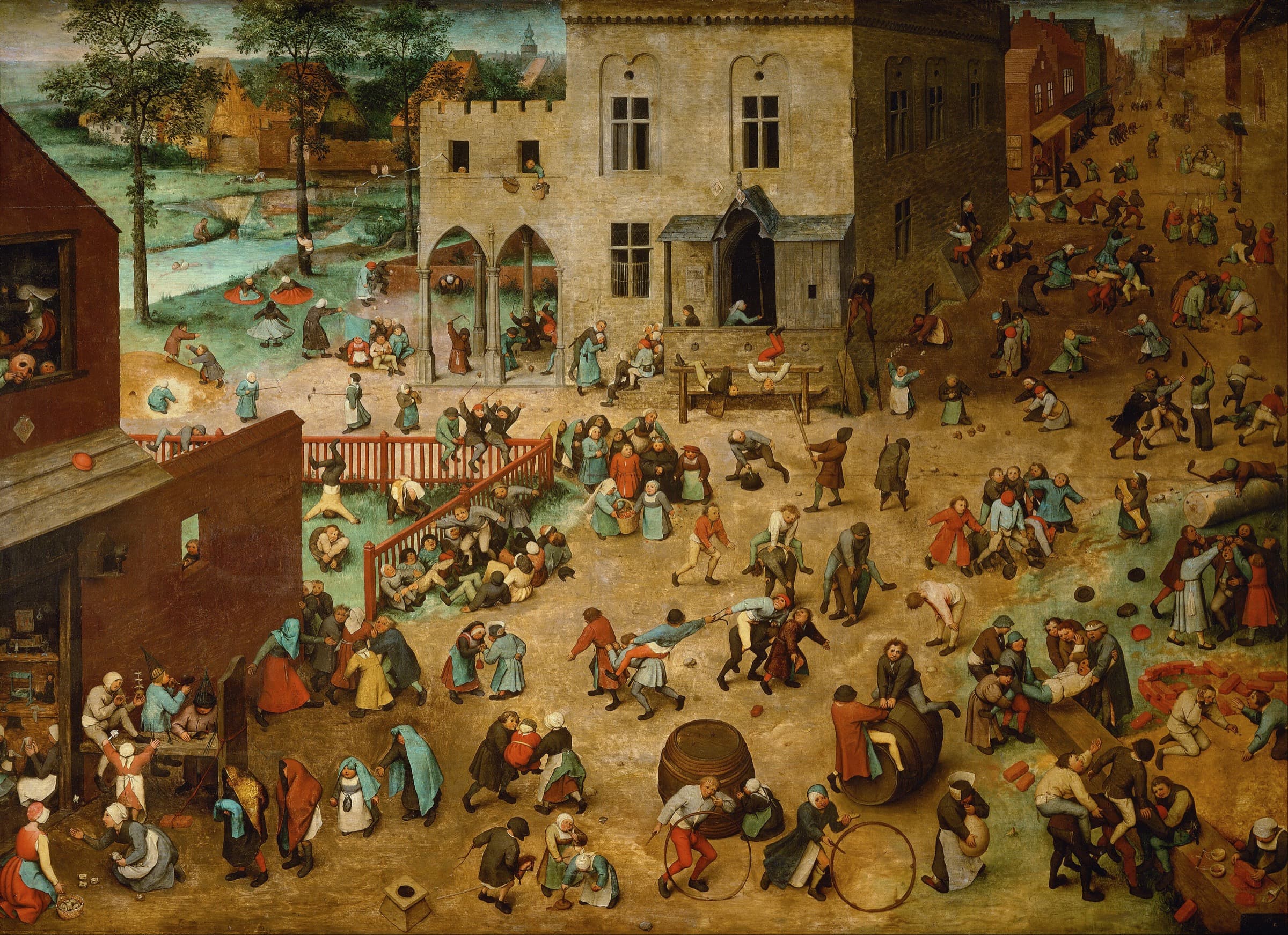
Tap a dot to see the game.
Game no. 11
Mock wedding
It is exactly at the diagonal centre of the panel. Perhaps an irony of the holy sacrament, or a reference to the main event that allows conception of children. Mock child weddings have been common folk tradition many places in Europe, and were often celebrated at Midsummer.
Every game in the painting (84)
Tap one to find it. Numbering follows Wikipedia, starting from the bottom left.
From a bird’s-eye view – the only way Bruegel could legibly fit in the impressive number of figures – the viewer looks down onto a wide square with a transition from an urban to a rural setting at the edges. On the right the view opens on to a long street laid out in central perspective and leading to the city centre, where a church steeple (or town-hall tower) soars into the sky. The battlement-crowned building at the edge of the square towards the city opens into an arcade running parallel to the course of the stream. At the left edge of the painting, an idyllic village appears on the horizon. Children – more than 230 in all – are occupied with 83 different games. The whole city seems to be theirs. Bruegel gives the beholder an encyclopaedic view of the children’s games of his time. The tininess ofthe figures and scenes forces a viewer seeking to decipher all the games to study the individual parts of the painting slowly and minutely – an entertaining pastime. However, some modern scholars have refused to accept such a humanistic-oriented, “simple” interpretation: the seemingly useless children’s activities have been regarded – probably incorrectly – as a parable forthe senselessness and foolishness of human behaviour. © Cäcilia Bischoff, Masterpieces of the Picture Gallery. A Brief Guide to the Kunsthistorisches Museum, Vienna 2010
This painting encapsulates the spirit of this app: a group of friends playing games, keeping score, and caring a little too much about who wins.
. The painting is in the public domain; image from the Google Art Project via Wikimedia Commons. Game numbers and most game notes come from the Wikipedia list (CC BY-SA 4.0).